An orthopedic implant may arrive in a sealed pouch, a rigid tray, and a labeled outer carton. Each layer helps protect the device during storage and transport. A torn seal, crushed corner, or unexpected opening can raise immediate questions about package integrity. Small marks matter. For surgical teams, clear signs of interference help guide careful inspection before an implant enters the operating room.
Why do orthopedic implants need to be packaged in tamper-proof containers? Because visible evidence of opening can help staff identify a package that needs closer review. Tamper-evident features may include seals that show damage when disturbed, secure closures, and packaging that makes unauthorized access easier to notice. These features support, but do not replace, validated sterile barriers, handling procedures, or clinical judgment. The right design depends on the implant, its packaging system, and how it will be shipped and stored.
Packaging is not a magic shield. A seal can be hard to interpret, and an intact-looking box cannot answer every question about handling. That deserves honest attention. Reliable packaging combines clear tamper evidence with legible labels, durable materials, and practical inspection steps. When these details work together, healthcare professionals can make better-informed decisions and protect confidence in the device before use.
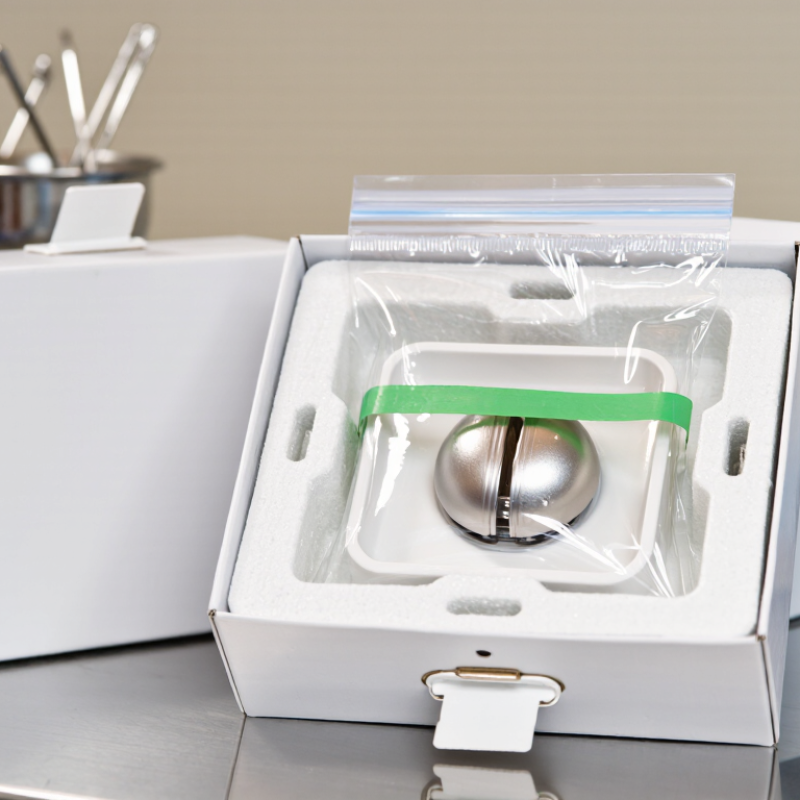
Why Do Orthopedic Implants Need Tamper Proof Packaging?
Orthopedic implants travel through sterilization, storage, transport, and operating-room handling. A sealed pouch or rigid tray must protect against contamination and physical damage. Screws can shift; sharp edges can puncture a barrier. Small details matter. “Tamper-proof” is not absolute: packaging cannot prove every handling event, but visible evidence of opening can alert staff to a compromised pack.
ISO 11607-1 sets requirements for materials, sterile barrier systems, and packaging systems used for terminally sterilized medical devices. It expects the system to maintain sterility until use and protect the device during distribution. The standard does not prescribe one universal tamper-evident feature. Manufacturers select and validate packaging for the implant’s weight, geometry, sterilization method, and expected shipping conditions. Process validation for forming, sealing, and assembly is addressed in ISO 11607-2. Seal strength, integrity, and aging evidence should support the chosen design—not merely a reassuring label.
The clinical stakes are real, though packaging alone cannot prevent infection. The World Health Organization’s Global Guidelines for the Prevention of Surgical Site Infection report that surgical-site infection affects up to 11% of patients undergoing surgery in some low- and middle-income settings. That figure is not a packaging-failure rate. It does underline why teams inspect seals, indicators, and trays before opening. A torn corner or loose seal deserves attention, even when the implant looks untouched. Human checks are imperfect, too.
ISO 11607-1: Packaging considerations in the sterile supply chain
This chart is a topic-coverage map, not a compliance score: 1 means the subject is addressed within ISO 11607-1’s requirements or scope. The standard focuses on packaging that maintains sterility until point of use. Tamper-evident features can help reveal interference, but they do not replace sterile-barrier integrity, validation, or appropriate handling.
Why Do Orthopedic Implants Need Tamper Proof Packaging?
Tamper Evidence Before Use: What ASTM F1886 Seal Inspection Can Reveal
An implant package may look intact while its seal hides a channel, wrinkle, or incomplete bond. Before use, staff should inspect the sterile barrier for signs of opening, puncture, moisture, or seal damage. These clues matter around a hip stem or spinal screw, where packaging may be handled during transport and preparation. ASTM F1886/F1886M, the standard test method for visual seal inspection of medical packaging, helps identify visible defects. ASTM describes detection of defects around 75 micrometers under suitable inspection conditions. That is useful, but not a guarantee: visual inspection cannot reveal every defect or prove sterility on its own. A clean-looking pouch is not proof.
Tips: Check the full seal edge under good lighting. Look for channels, folds, residue, or an uneven bond. Compare questionable packages with the device’s handling and inspection procedures, and do not use packaging that appears compromised. ISO 11607-1 addresses sterile barrier systems for terminally sterilized medical devices; its packaging requirements complement, rather than replace, careful checks before use. In practice, inspectors can miss subtle defects when rushed. It is worth admitting that limitation.
| Visible observation | What it may indicate | Why it matters for an orthopedic implant | What visual inspection can establish | Important limitation |
|---|---|---|---|---|
| A channel or visible gap across the seal | An apparent discontinuity in the sealed area | May signal a compromised sterile barrier and should prompt assessment before use. | ASTM F1886/F1886M visual inspection can identify visible seal defects under defined inspection conditions. | A visual examination does not prove sterility or detect every leak or microscopic defect. |
| Wrinkles, folds, or creases crossing the seal | Possible interference with seal formation or a locally uneven seal | A visible irregularity can be a reason to hold the package for evaluation rather than assume the barrier is intact. | Inspection may reveal the location and visible extent of the irregularity. | Appearance alone does not determine whether the seal meets validated acceptance criteria. |
| Foreign material or contamination visible in the seal area | Material may have been caught in or near the seal | The finding may affect confidence in package integrity and warrants following the applicable inspection and disposition procedures. | Visual inspection can document visible contamination or inclusions at the seal. | It cannot identify all contaminants or establish microbial status. |
| An incomplete, uneven, or unusually narrow-looking seal | Possible variation in the seal’s visible continuity or appearance | Consistent seals support reliable sterile-barrier packaging for devices that must remain protected until use. | Inspection can reveal observable variation for comparison with the packaging process’s approved criteria. | Do not apply a universal minimum seal width; acceptance limits are product- and process-specific. |
| A torn, punctured, or otherwise visibly damaged package | Physical damage that may compromise the sterile barrier | Damage can undermine confidence that the implant has remained protected during handling and storage. | A receiving or pre-use visual check can identify visible damage and support appropriate escalation. | The absence of visible damage is not proof that the package has no integrity defect. |
| Evidence of opening, resealing, or disturbance of a tamper-evident feature | Possible prior access or package handling inconsistent with an undisturbed presentation | Tamper-evident features help users recognize signs of interference before opening the sterile package. | Visual examination may reveal visible signs of disturbance when the packaging design makes them observable. | ASTM F1886/F1886M is a seal visual-inspection method, not a test or certification of tamper resistance. |
| No obvious defect under the inspection conditions | No visually detectable issue was observed in the inspected area | A documented visual check is one part of package controls and pre-use assessment. | The result describes what was visible using the specified inspection procedure. | Visual inspection complements, but does not replace, validated package integrity testing or package-process controls. |
Orthopedic implants may sit in storage for months before surgery. A sealed pouch can be crushed in transit, nicked by a tray, or weakened along one narrow seam. Tamper-evident packaging helps staff notice interference, but an intact-looking seal does not prove the sterile barrier is sound. Small defects matter.
ASTM F1929-23 provides a dye-penetration method for finding channels in seals of porous medical packaging. The standard describes three dye-application procedures. In practice, a technician applies dye to the seal edge and watches for a visible path through the seal. The result is recorded as penetration or no observed penetration, with the test location and conditions documented. A pin-sized channel can reveal itself as a colored line. That is useful evidence, not a guarantee of sterility.
The test supports the broader packaging-validation framework in ISO 11607-1, which addresses sterile-barrier systems for terminally sterilized medical devices. Dye testing is destructive and evaluates the tested area; it cannot certify every package or detect every failure mode. Teams should pair it with validated sealing controls, visual inspection, and risk-based sampling.
One awkward truth: a clean result can still create false confidence if the sampling plan is weak. A good test needs good judgment.
Orthopedic implants can have sharp edges, dense metal components, and delicate coatings. Their packaging must protect the sterile barrier during handling, shipping, and storage. Tamper-evident features can help reveal unauthorized access, but they do not replace package validation. ISO 11607-2 focuses on validating the processes used to form, seal, and assemble packaging for terminally sterilized medical devices. A strong-looking seal is not enough.
Validation should show that equipment and process settings consistently produce acceptable seals. Teams typically document installation qualification, operational qualification, and performance qualification. They assess factors such as temperature, pressure, dwell time, and seal appearance. Testing should include realistic challenges, such as the largest implant tray or the least favorable sealing conditions. Record the approved operating range, inspection criteria, and response to deviations. Small details matter. A wrinkle near a tray corner may become a leak path. Results also need review when materials, equipment, or process settings change. In practice, some failures only appear after distribution testing, so validation should not end at the sealing machine.
Tips: Keep a clear record of each run, including settings and rejected packages. Train operators to spot seal channels, folds, and contamination. Do not assume yesterday’s successful batch proves today’s process is controlled. Recheck assumptions.
FDA UDI rules connect package identification with implant traceability, but they do not themselves require tamper-evident packaging. Under 21 CFR 801.20, a device label and applicable package levels must bear a Unique Device Identifier, subject to regulatory exceptions. FDA’s UDI framework has two elements: a Device Identifier and, when applicable, a Production Identifier. The first identifies the device and labeler; the second can identify details such as lot or serial number. A readable UDI helps staff link a sealed implant carton to its records. It cannot show whether that carton was opened or compromised.
Tips: Check the seal before accepting an implant. Scan the UDI, then compare the device and package details with the receiving record. If a seal looks lifted or crushed, pause and document the discrepancy. Small details matter.
Tamper-evident features add a visible package-status cue to the UDI’s identification function. A broken seal beside a scannable code creates a clearer handoff record for storage, operating-room preparation, and investigation. FDA’s 2013 UDI Final Rule established the identification framework; packaging controls complement it rather than replace it. A seal is not a database. Nor does a clean-looking package prove every handling step was correct. Teams should record seal checks and UDI scans consistently, while recognizing that real workflows can miss a step.
(Sources: FDA, 21 CFR 801.20; FDA, Unique Device Identification System Final Rule, 2013.)
Packaging helps keep implants sterile and protects them from damage during storage, transport, and handling. Screws can shift, and sharp edges may puncture a barrier.
No packaging can prove every handling event. Visible signs of opening can alert staff to possible compromise, but they are not a complete record.
It should help maintain sterility until use and protect the device during distribution. The design should suit the implant’s shape, weight, and sterilization method.
Check the full seal edge under good lighting. Look for tears, punctures, moisture, wrinkles, residue, or uneven bonding.
Yes. A hidden channel or incomplete bond may not be obvious at first glance. A clean appearance does not prove sterility.
It can help identify visible defects, including some around 75 micrometers under suitable conditions. It cannot detect every defect or confirm sterility by itself.
Follow the device’s handling and inspection procedures. Do not use packaging that appears damaged. When unsure, pause and seek guidance.
Forming, sealing, and assembly processes should be validated. Seal strength, integrity, and aging evidence should support the design.
No. Packaging checks are only one part of infection prevention. Human inspections can miss subtle defects, especially when staff are rushed.
Why do orthopedic implants need to be packaged in tamper-proof containers? Because their packaging helps preserve sterile-barrier integrity and provides visible evidence of possible interference before use. Under ISO 11607-1, packaging for terminally sterilized medical devices is designed to maintain sterility through handling, storage, and distribution. ASTM F1886 visual inspection can reveal irregular seals or other visible defects, while ASTM F1929 dye-penetration testing can help identify leaks in suitable porous packaging.
Reliable packaging also depends on validated production processes. ISO 11607-2 addresses validation of forming, sealing, and assembly processes so that packaging consistently meets its intended requirements. When package condition is checked alongside implant identification, FDA Unique Device Identification requirements under 21 CFR 801.20 support accurate identification and traceability. Together, these measures help healthcare teams assess whether an implant’s package is intact, confirm its identity, and make informed decisions before opening it for use.

Voila Orthopedic Implants